
Space Age
The view from beyond

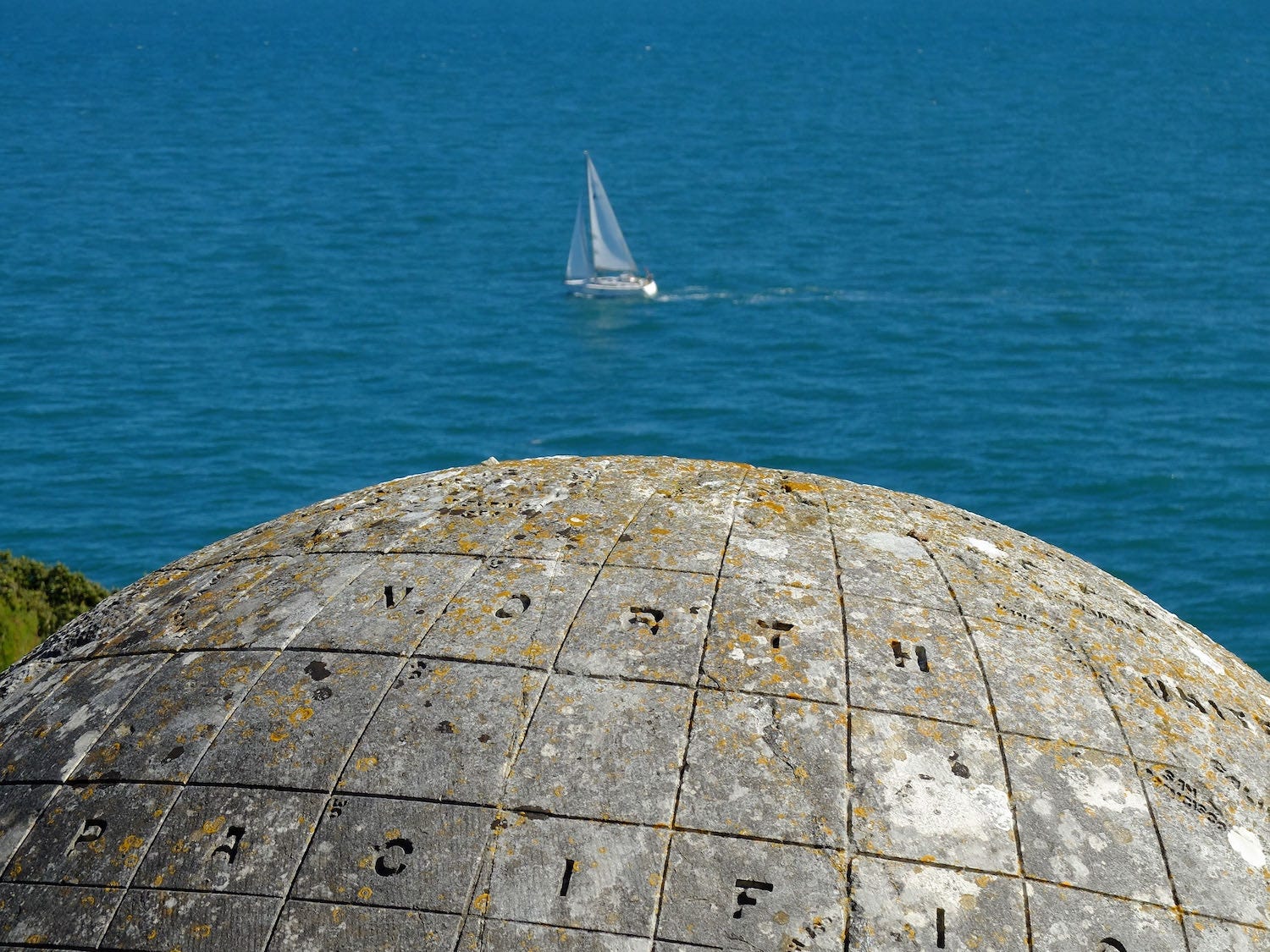
Once upon a time, far into the future, I can imagine it will be common for people to book two weeks in a nice chalet on the edge of the Isidis Basin with distant views of Elysium Mons. They will, of course, take whatever passes for a camera with them and send images to their friends back on earth – the rocky outcrops, the strange skies or the kids playing in the red dust of Mars.
It is perhaps inevitable that anyone imagining a future does so through the filter of what they already know. There’s a series of late-19th century postcards imagining the world in the year 2000 that are good examples of this. Devices for flying to an evening at the Opera are basically airships or have flapping canvas wings. The cutting-edge of modernity is there in that many of the future inventions are powered by electricity, but the vision is of an electro-mechanical world where the juice is applied to wires, dials and chunky levers. Those 19th-century visionaries could not make the leap to jet propulsion or wireless technology. They even peopled their future with women in fancy hats and men with extravagant facial hair. So, I have to wonder what I’m not getting when I imagine taking the great great grandkids to Mars at half term.
Technologically, I can only extrapolate from where we are now – which is what those postcards did – and miss seismic developments. Teleportation, anyone? But, since image-making, recording and seeking information are all embedded centuries into our past as a species, I think those will be something at least to act as a constant.
Photography has given us means that were not available just two centuries ago to gather reliable images from anywhere in the world. Within a decade or so of its invention, the medium was being used by Europeans to record what they found on their travels. Photographs of The Great Pyramids or the vast spaces of unsettled America gave people back home windows into places they would almost certainly never visit. They also acted as an inventory of cultural treasures and places to be plundered or annexed.
Last month, the Artemis II spacecraft returned to earth having taken humans deeper into space than ever before. Of course, they sent back photographs while they were up there. It’s a measure of how space travel has become an accepted part of human activity that many of those images were familiar to us; we could place them and, in our lay-person way, understand them. A moody grey surface pocked with craters curving away into the blackness of space is almost as everyday as blue skies and yellow beaches.
But the pictures sent back from the Orion spacecraft moved the dial on familiarity a little further. It was left to the automatic, external cameras of the vessel to give us the craters and the blackness. The crew inside were using an older-model digital camera, the Nikon D5 chosen because its thoroughly known qualities would offer no surprises that might spoil the moment, as well as their iPhones. And the way they used those cameras was also familiar.
The first time we saw the blue/green Earth suspended in the vastness of space in 1969, we were astonished. Now, what was once wondrous is borderline cliché. But that iconic view was given a new dimension by the Artemis crew who – rather than framing the earth in the unfathomable isolation of 1969 – chose to show it as a passing scene through the windows of their spacecraft, often with portions of their own faces in the image. They anchored the distant Earth within the frames of what were essentially holiday snaps. In doing so, they offered the hope that, one day, any of us might get to see the same thing with our own eyes.
There was nothing accidental about this. Space travel is astronomically expensive and potentially takes resources away from more pressing earthbound needs. You need to get people on board with the idea. In 1969, the trip to the moon was justified in the grandest terms as the pinnacle of Human endeavour and essential for the whole planet. In the 21st century, the approach has been different and NASA’s PR has moved from the grandiose to the ordinary. NASA accounts on Instagram and updates on X livestreamed the crew floating around in their capsule, and the stills and selfies that came back were an intentional part of this social media ecosystem.
In fact, the mission itself was not primarily one of scientific discovery. The backside of the moon had already been photographed and studied by China and India. Those countries, though, relied on remotely controlled technology to gather their images. Conventional digital photographic means were used, but there was no human behind the viewfinder. It’s an incremental method of eventually setting our eyes on deeper and deeper space. Start with the robots, then get some people up there. For nearly 15 years, rovers have been pottering around on Mars sending back photographs that are both strange and familiar. One day…
From where we are now to getting any further, we are going to need something more than lenses and chips. We’ll need photography, but not as we know it. The Hubble and James Webb telescopes that peer into deep space and deep time, send us astonishing snaps of swirling, ethereal clusters and flecks of light representing places that none of us will ever see. The Eagle Nebula containing The Pillars of Creation, for example – six thousand light years away.
These images are not like those of the Moon’s dark side or Earth spinning past the window. They are not a simple tweak of the focus and click of the shutter. Instead they are meticulous assemblages of information gathered over several passes, often of light wavelengths that are invisible to our eyes. Something like the Wide Field Camera on the Hubble may be based around technology that any digital camera user of today can understand – a CCD giving images 4,000 x 4,000 pixels – but it adds in separate filters for different wavelengths and an array of post-processing tools to make a kind of dense, informational sense across the full spectrum of light.
When the pictures finally land on Earth, they may as well be abstract – unless you’re an astrophysicist. It’s not like the friendly face of the Earth or even the barren deserts of Mars. The deep space telescopes show us places where we could never get a foothold, or hold on to any anchor. It’s unlikely that, were we to somehow open our eyes up there, we would actually see anything like the gorgeous, swirling clouds of gas and dust or the twinkling jewels of distant stars. Looking at the well-understood images from Artemis we know where we are. But out there, way out there, viewpoint and scale have become detached from our experience and we are left with nothing but beauty and strangeness to hang our imaginations on.
History Corner
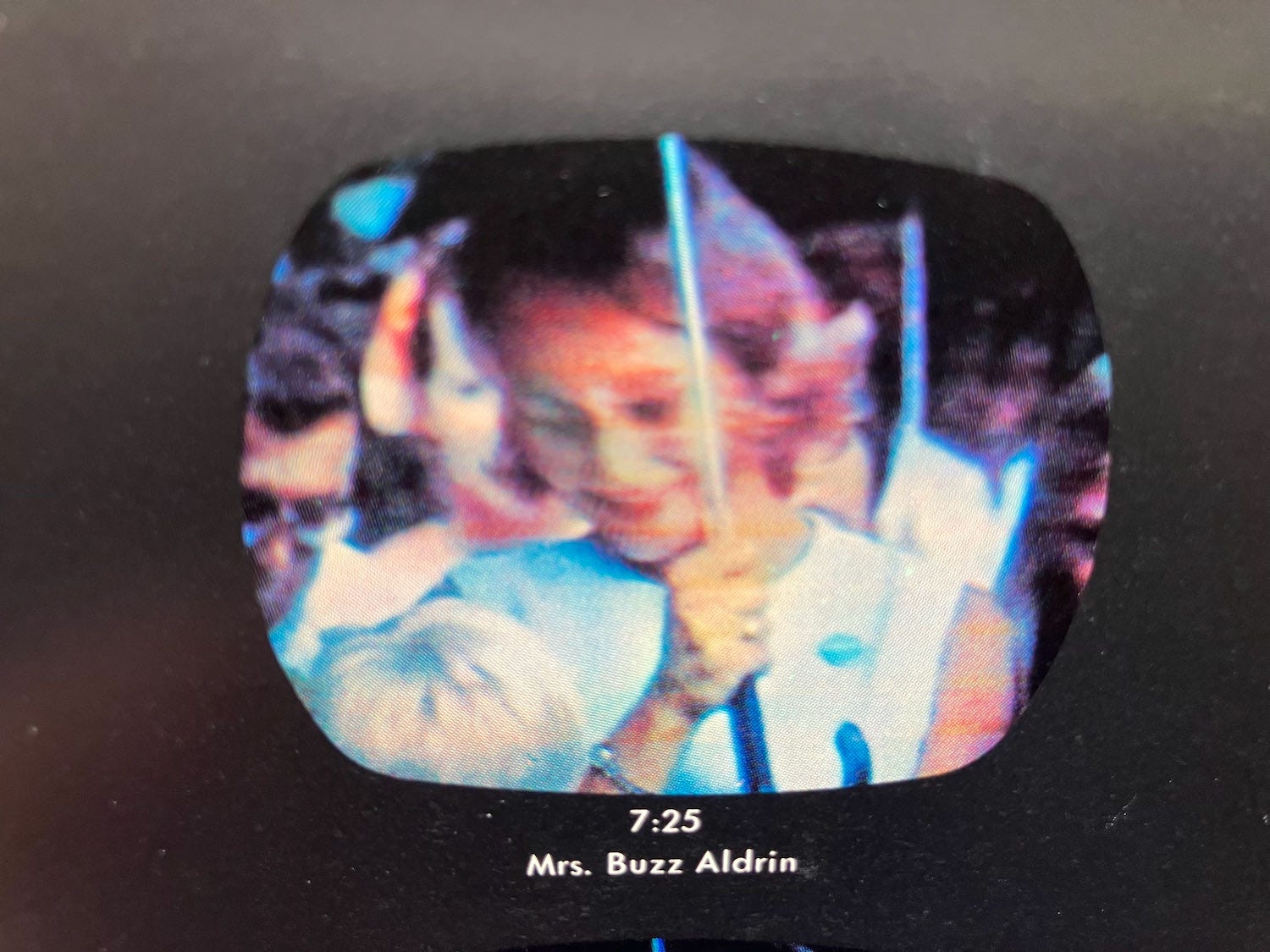
In 1970, one year after the Apollo moon landing, CBS decided to pat themselves on the back and create a lasting monument in the form of a large book not just to the landing itself, but to their reporting of the event. To be fair, that was a massive achievement - international live coverage which included reports, debate, and footage from space; probably the most complex live TV programme of its day.
The book is a beautifully designed thing, with moon-beige covers embossed with shallow craters and endpapers that consist of diagrams of the astonishing slingshot orbiting technique that got the astronauts there and then back again.
Essentially, it is a condensed transcript of everything that happened across the whole broadcast, from studio guests to famous anchor men, with a sprinkling of outside broadcast interviews from as far away as the front line in Vietnam. Verbatim extracts of the talking, presenters giving updates to the viewing public, the thoughts of luminaries including Arthur C Clarke, Kurt Vonnegut and Ray Bradbury, bookend a central section of small TV screengrabs printed in glossy inks on deep black pages.
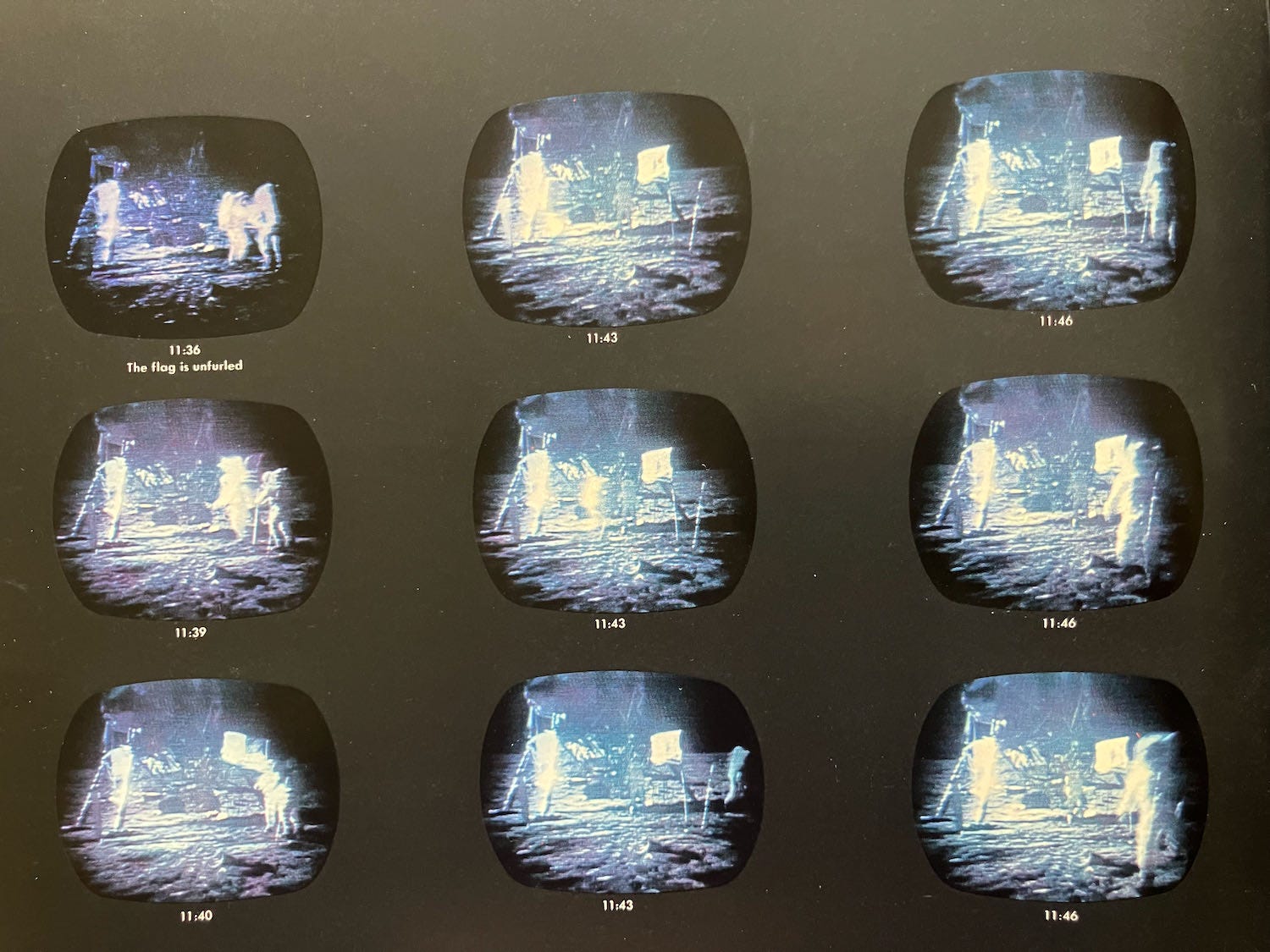
There’s a ghostly quality to these images and it is just as present in those taken on Earth as it is in those taken of the moon. Because they have not been directly taken from the continuous flow of life but second-hand from video recordings, there’s a distance to them. They are delicate, ephemeral things. But I don’t think it’s just the low resolution of early technology that makes these fleeting pictures as fragile as bubbles, it’s also the way they are presented in rounded frames to imitate a 1960s TV screen.
This simple device and the shiny surfaces of the images may have suggested immediacy and modernity to those who first bought this book. Looking at it now, there’s a sense of a stuttering analogue signal. A world and an event barely glimpsed between static bursts of interference, where the next thing up is likely to be a white dot in the centre and a continuous flatlining bleep.

Meanwhile, back on Earth, The Critic had this advice for Vanessa in the September 1900 issue of Practical and Junior Photographer…
“Vanessa - No, this will not do. You see the lady’s face is not suitable for the treatment. We feel confident that her features could have been taken from some point of view which would have given a more pleasing result. With another model possessed of a firt-class profile this lighting would be excellent; with the present lady, however, who is plainly only intended for a full-front reproduction, it is altogether unsuitable.”
Thanks for reading.
Really enjoyed this. I’ve made use of the Artemis II mission as an extended metaphor for the state of photography education but I was more focused on the toilet! Your observation about the visibility of the Pillars of Creation is fascinating. What do photographs help us to see? When do they prevent us from seeing what’s also there? It’s as true of those early landscapes of colonised lands as it is of deep space!